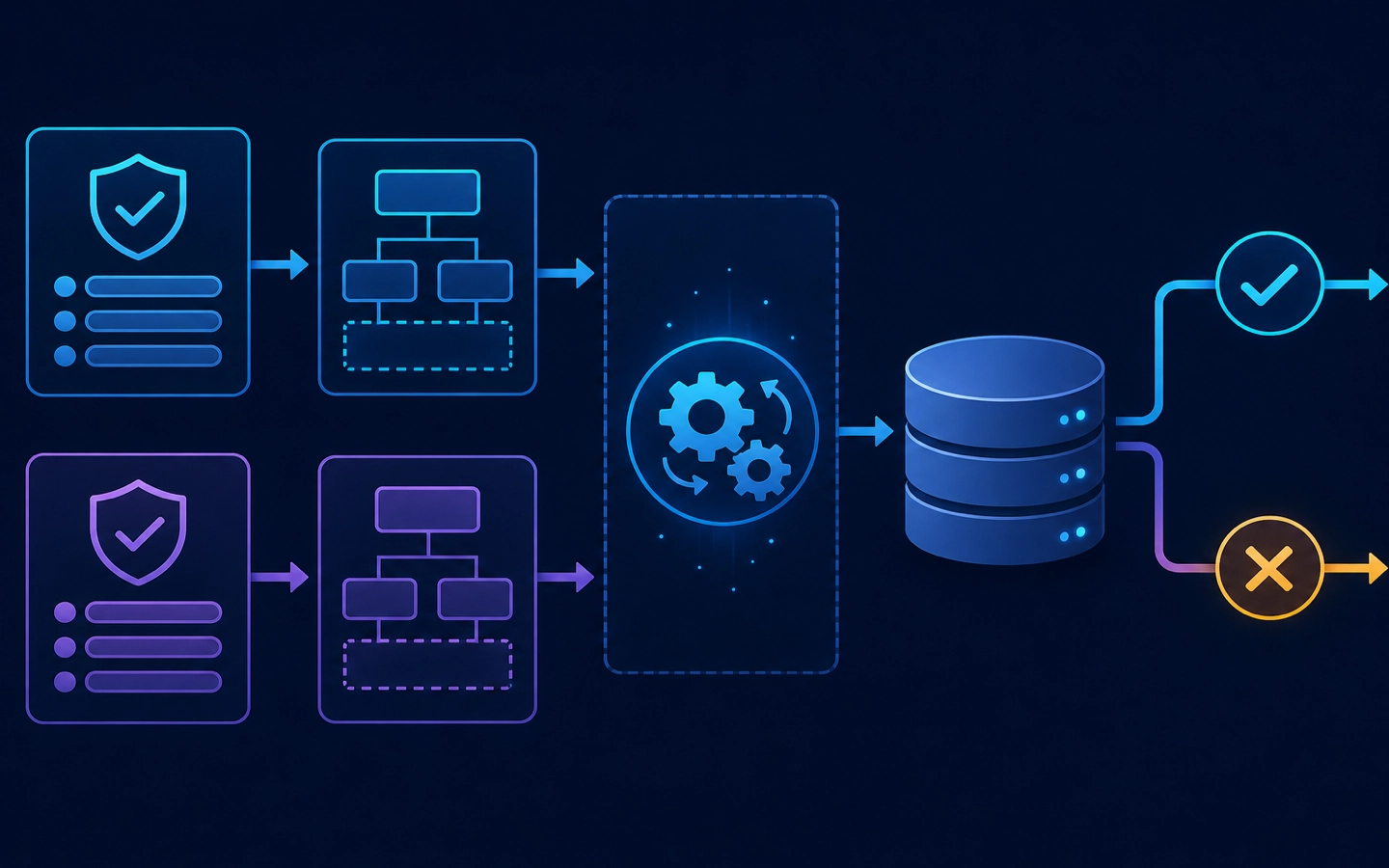
Database Access in Rust with SQLx featured illustrationContents
SQLx gives Rust applications an asynchronous database interface without hiding
SQL behind an ORM abstraction. The important design work is still yours:
configure a bounded pool, bind untrusted values, separate migrations from
runtime queries, and make transaction boundaries explicit.
Learning outcomes
create a pool from configuration rather than source-controlled secrets;
use parameterized queries for user-controlled values;
distinguish compile-time query checking from runtime database availability;
run a transaction and understand commit and rollback behavior;
set bounded timeouts and map failures safely.
Prerequisites
Have stable Rust, Cargo, and access to a disposable local database for the
hands-on portion. Choose the SQLx driver and runtime features deliberately; the
examples below use PostgreSQL types and Tokio, but the same design principles
apply to other supported drivers with syntax differences.
text
[dependencies]
sqlx = { version = "0.8", features = ["runtime-tokio", "postgres", "migrate"] }
tokio = { version = "1", features = ["macros", "rt-multi-thread"] }
Verify current versions and feature names before implementation.
Keep connection settings out of code
Use a secret manager or protected environment configuration in the application
runtime. Never place a password in source, a tutorial URL, a shell transcript,
or an error message.
rust
use sqlx::{postgres::PgPoolOptions, PgPool};
use std::time::Duration;

async fn connect(database_url: &str) -> Result<PgPool, sqlx::Error> {
    PgPoolOptions::new()
        .max_connections(8)
        .acquire_timeout(Duration::from_secs(5))
        .connect(database_url)
        .await
}
The pool limit is an application decision. It should reflect database capacity,
request concurrency, and timeout behavior rather than an arbitrary large value.
Parameterize values
Parameterized values protect the value boundary; authorization remains application work.
Use bind parameters for values supplied by a caller or another untrusted source:
rust
use sqlx::PgPool;

async fn find_note(pool: &PgPool, owner_id: i64) -> Result<Option<String>, sqlx::Error> {
    sqlx::query_scalar("SELECT body FROM notes WHERE owner_id = $1 ORDER BY id LIMIT 1")
        .bind(owner_id)
        .fetch_optional(pool)
        .await
}
Binding protects the value boundary; it does not validate authorization or make
an arbitrary query safe. Identifiers such as table names need a separate,
allowlisted design because they cannot normally be bound as values.
Migrations are a separate lifecycle
Keep schema changes versioned and reviewed. Run migrations through the approved
deployment process, not opportunistically from every request handler. A local
development migration might create a notes table, but this editorial package
does not prescribe a production schema or execute a migration.
When using SQLx’s compile-time query macros, understand what database metadata
must be available during compilation and how the lockfile and offline metadata
are maintained. A compile-time check is not a substitute for runtime tests.
If a later operation returns an error before commit, dropping the transaction
rolls it back according to SQLx’s transaction behavior. Test both success and
failure paths; do not assume rollback if the connection has already failed.
Handle errors without leaking internals
Classify errors for the caller and logs separately. A duplicate-key error may
become a bounded conflict response, while a database-unavailable error may
become a retryable service error. Logs should contain a correlation identifier
and safe classification, not passwords, connection strings, query parameters,
or full database responses.
Common mistakes and troubleshooting
Pool exhaustion: lower request concurrency, inspect slow queries, and choose pool and timeout bounds together.
Compile-time query failure: confirm the selected driver, schema metadata, feature flags, and SQL dialect.
Transaction appears committed: verify the code reaches commit and that all related statements use the same transaction executor.
Unsafe string interpolation: replace value interpolation with .bind(); use allowlists for structural SQL choices.
Migration drift: inspect the migration history and lockfile rather than editing a live schema manually.
Security and production considerations
Use least-privilege database identities, TLS where supported, secret rotation,
bounded pool sizes, statement and request timeouts, backups, migration review,
audit-safe logs, and authorization checks at the application boundary. SQLx does
not decide whether a caller may read or mutate a row.
Summary
SQLx keeps SQL visible while providing async pooling and optional compile-time
checking. Safe database access still depends on parameter binding, explicit
ownership of transactions, bounded resources, and careful operational review.
Next step and technical review flags
Continue with Unsafe Rust and FFI. Verify current
SQLx feature flags, driver support, query-macro behavior, transaction semantics,
and migration workflow against the official SQLx repository and documentation.
Compile the examples with the exact approved dependency versions and a
disposable database before publication.







No comments yet. Start the discussion.