Building a JSON API with Rust and Axum featured illustrationContents
Axum provides routing and request handling on top of the Tower service model.
This tutorial builds a deliberately small JSON API, then shows where validation,
state, and middleware belong. It is a learning example, not a production
deployment recipe.
Learning outcomes
create an Axum router and serve it with Tokio;
parse a path parameter and JSON request body;
share application state explicitly;
separate validation errors from transport failures;
identify the additional controls required before production.
Prerequisites
Have stable Rust and Cargo installed. Create a project with cargo new and add
versions compatible with the current stable Axum release after checking the
official release documentation.
text
[dependencies]
axum = "0.8"
serde = { version = "1", features = ["derive"] }
serde_json = "1"
tokio = { version = "1", features = ["macros", "rt-multi-thread", "net"] }
The version ranges are illustrative and must be resolved and locked during
implementation. Do not copy them into a production project without review.
Attach it with post("/notes/{id}", create_note). Validate size, encoding,
authorization, and business rules before accepting real input. The example does
not persist data or authenticate a caller.
State should contain handles and configuration with clear ownership. Keep
request-specific data in the request, not in mutable global state.
Validate and model errors
An API should return a stable public error shape while logging only safe,
correlation-friendly details. A real implementation can define an error type
that implements Axum’s response conversion and maps validation failures to
400, missing resources to 404, and authorization failures to 401 or 403
according to its policy. Never return stack traces, secrets, SQL text, or raw
upstream responses to clients.
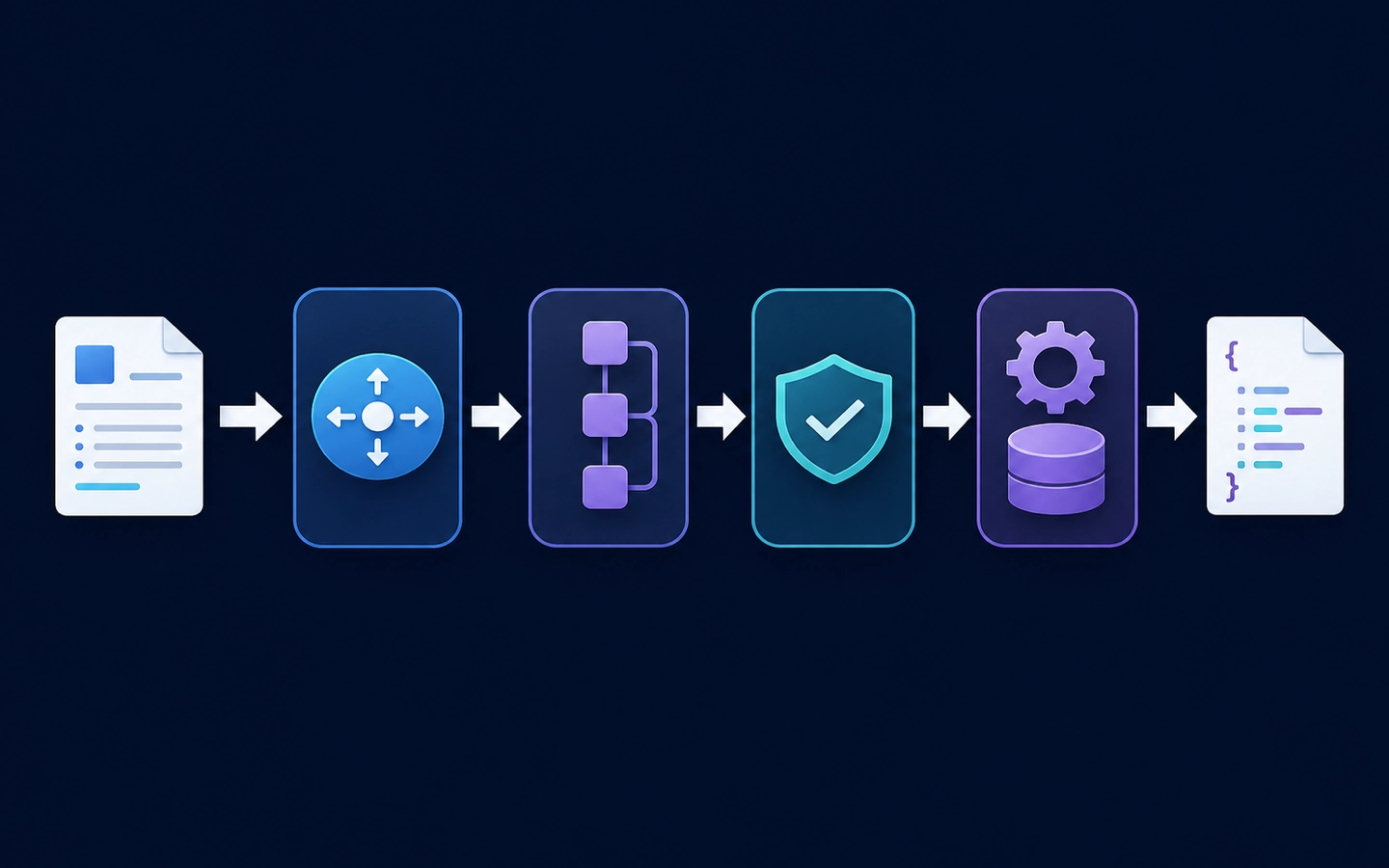
Request flow
Keep transport, validation, authorization, and application logic explicit.
The router matches the method and path.
Extractors parse path, query, headers, and body.
Validation checks shape, size, and business constraints.
Authorization checks the caller and requested resource.
The handler calls an owned application service.
The response maps success or a bounded public error.
This separation makes unit tests small and makes middleware responsibilities
visible.
Common mistakes and troubleshooting
Handler does not satisfy the route: check extractor order and return type.
Body extraction fails: send valid JSON with the correct content type and enforce a body limit.
State cannot be cloned: store an Arc or a cheap, cloneable handle rather than copying a connection or secret.
Runtime blocks: do not perform blocking file or database work on the async executor; use an appropriate blocking boundary.
Unexpected 404: verify method, path parameters, and router nesting.
Security and production considerations
Add authentication, authorization, CSRF or origin controls where applicable,
rate limits, body and header limits, TLS, timeouts, bounded concurrency,
structured redacted logs, graceful shutdown, and health/readiness separation.
Do not treat a local 200 OK as proof of production readiness.
Summary
Axum makes the route and extraction layers compact, but a reliable API still
needs explicit validation, authorization, bounded resources, and safe error
mapping. Keep the tutorial service local and extend it only after each boundary
has a testable contract.
Next step and technical review flags
Continue with Database Access in Rust with SQLx.
Confirm current Axum, Tokio, Tower, extractor, route-parameter, and server APIs
against their official documentation before publication. Compile and exercise
the complete example against the locked dependency versions.










No comments yet. Start the discussion.