
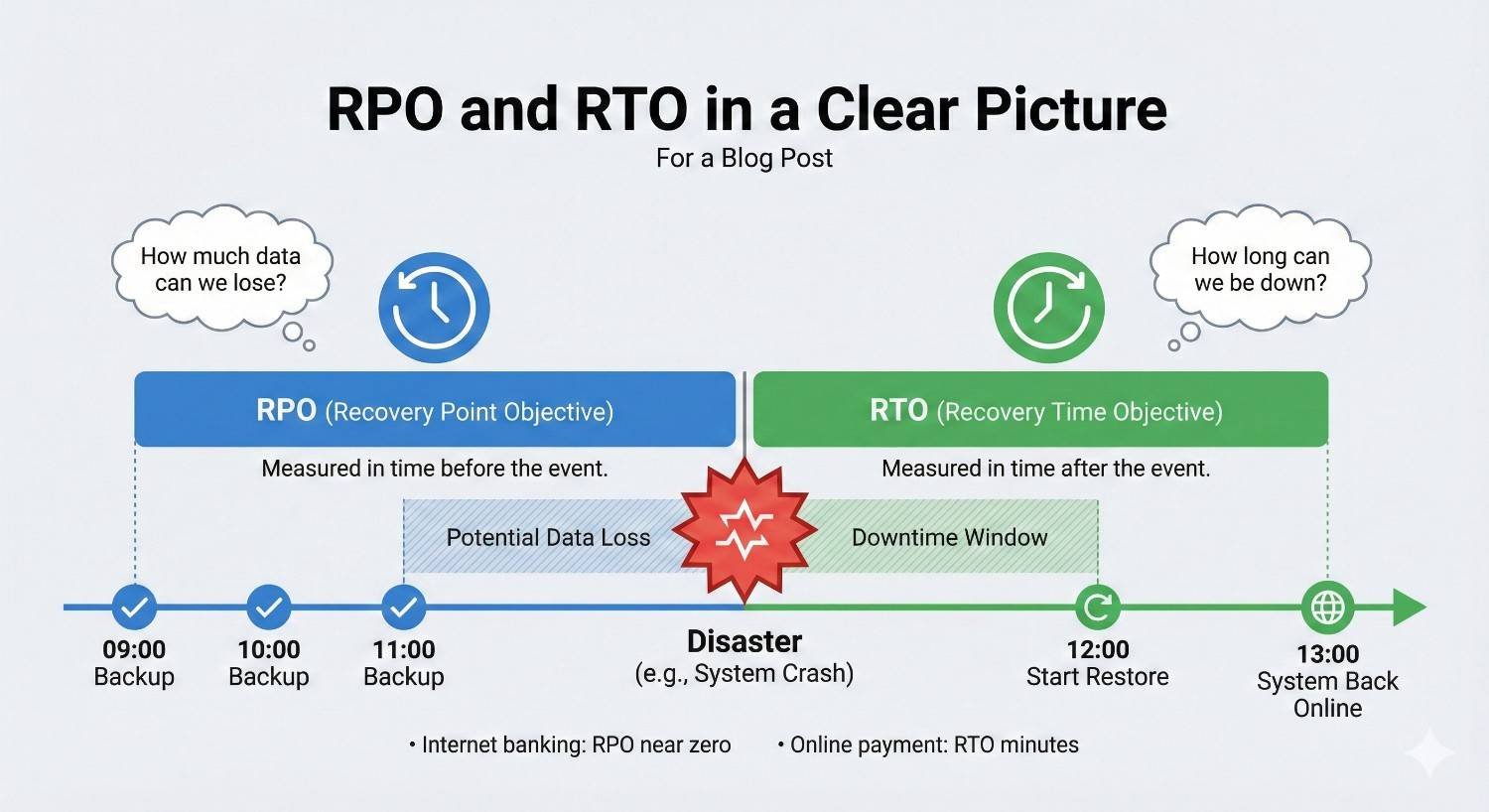
Recovery point objective (RPO) and recovery time objective (RTO) turn business impact into measurable recovery targets. RPO defines how much recent data loss is acceptable, measured backward in time. RTO defines how quickly a service must be restored after disruption.
RPO and RTO answer different questions
| Metric | Business question | Primary design influence |
|---|---|---|
| RPO | How much data can we afford to lose? | Backup and replication frequency |
| RTO | How long can the service be unavailable? | Recovery architecture, staffing, and automation |
RPO example
If an order system has a 15-minute RPO and fails at 14:00, the organization accepts at most 15 minutes of lost transactions. Nightly backups cannot meet that target; frequent snapshots, log shipping, or continuous replication may be required.
RTO example
If the same system has a two-hour RTO, the service and its required dependencies must be restored within two hours of the declared incident. That window includes assessment, infrastructure recovery, data restoration, validation, network changes, and business handoff.
Targets must come from business impact
- Revenue and contractual impact of downtime.
- Safety, privacy, and regulatory obligations.
- Volume and value of transactions created over time.
- Operational workarounds available during an outage.
- Upstream and downstream system dependencies.
- Cost of the technology and staffing needed to meet the objective.
Map technology to the objective
| Target profile | Typical approach |
|---|---|
| Long RPO and RTO | Periodic backups with manual restoration |
| Short RPO, moderate RTO | Frequent snapshots or replication with planned recovery |
| Near-zero RPO, short RTO | Synchronous or continuous replication and automated failover |
| Critical service | Multi-site design, rehearsed failover, and dependency resilience |
Backups are not the whole recovery plan
A backup may protect data but not restore identity, DNS, networking, secrets, certificates, application configuration, or third-party access. Define recovery order, owners, credentials, clean-room procedures, validation criteria, and communication steps.
Test and measure actual recovery
- Restore data to an isolated environment.
- Record the real recovery point achieved.
- Time every recovery stage, including approvals and validation.
- Confirm application integrity with business owners.
- Document gaps and repeat the exercise after remediation.
Objectives are promises; achieved recovery metrics are evidence. Review both whenever services, data volumes, dependencies, or business tolerance change.
Join the discussion
0 CommentsAsk questions, add context, or share what worked.
More from Melochip Editorial
Learn what Playwright testing is, why modern QA teams use it, how testers can get started, and the major types...
7 min read · Sep 19, 2026

Learn how Kubernetes Deployments and ReplicaSets work with practical YAML, scaling, self-healing, rolling upda...
7 min read · Sep 17, 2026

Learn Kubernetes security best practices with RBAC, Secrets, ServiceAccounts, Pod securityContext, NetworkPoli...
6 min read · Sep 17, 2026Related articles

Learn Docker environment variables and secrets, including docker run -e, env files, Compose environment, secre...
2 min read · Sep 17, 2026
Learn how Kubernetes Deployments and ReplicaSets work with practical YAML, scaling, self-healing, rolling upda...
7 min read · Sep 17, 2026

Learn Kubernetes monitoring and logs with kubectl logs, events, metrics-server, top commands, Prometheus, Graf...
5 min read · Sep 17, 2026
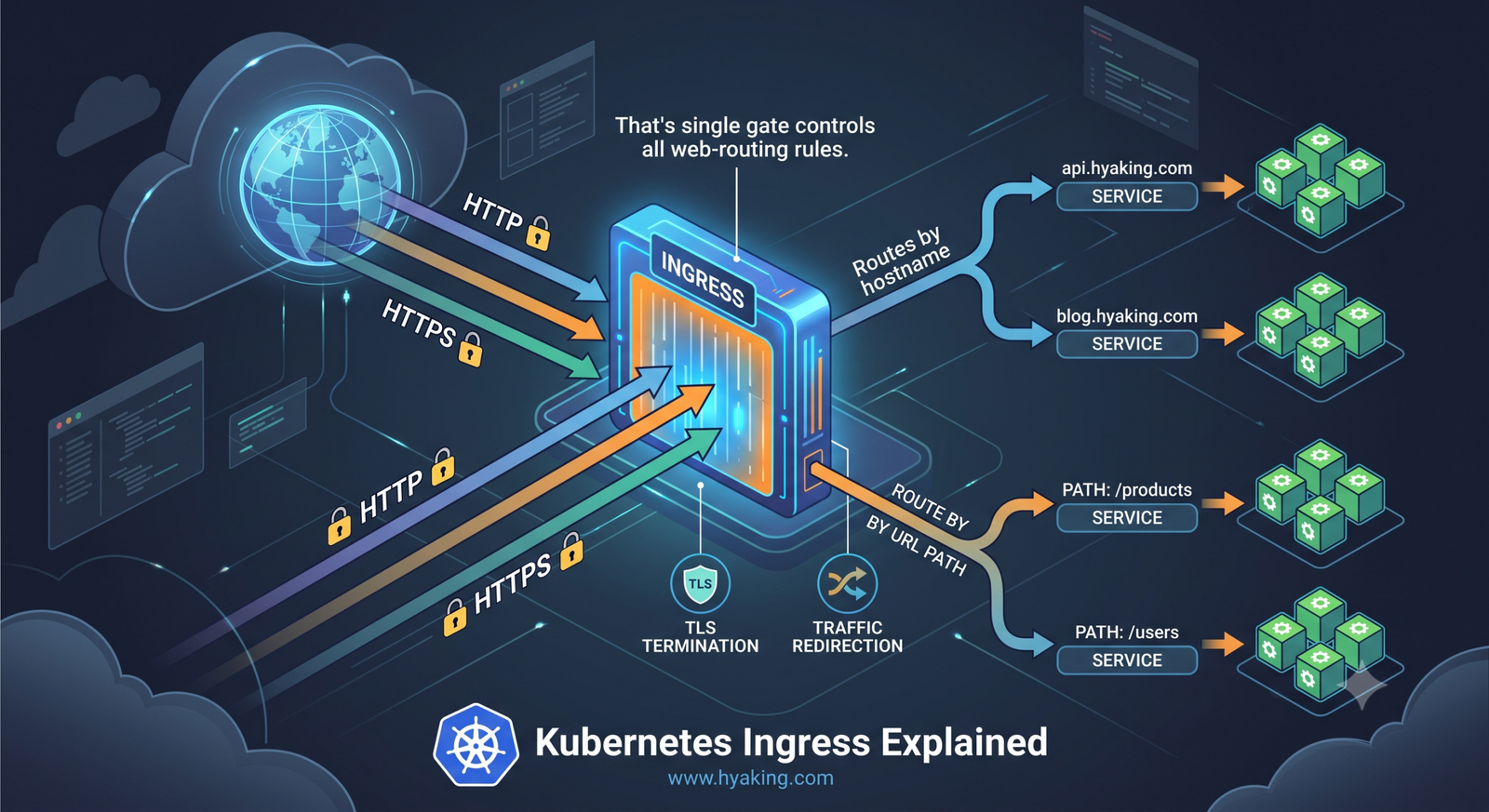
Learn Kubernetes Ingress with controllers, IngressClass, host and path routing, TLS, DNS, annotations, redirec...
8 min read · Sep 17, 2026Stay in the loop. Get new Melochip articles
Receive Melochip article updates when new articles are available. Explicit opt-in only.
No comments yet. Start the discussion.