DevOps Artifact RepositoryDevOpsPackage ManagementSoftware Supply Chain

Article & Tutorial

Best Artifact Repository Managers: Artifactory, Nexus, GitLab and Cloud Registries

Compare artifact repository platforms across package formats, proxy caching, containers, security, governance, cloud integration, operations, and enterprise use cases.

Enterprise artifact repository managers and cloud package registries comparison
Contents

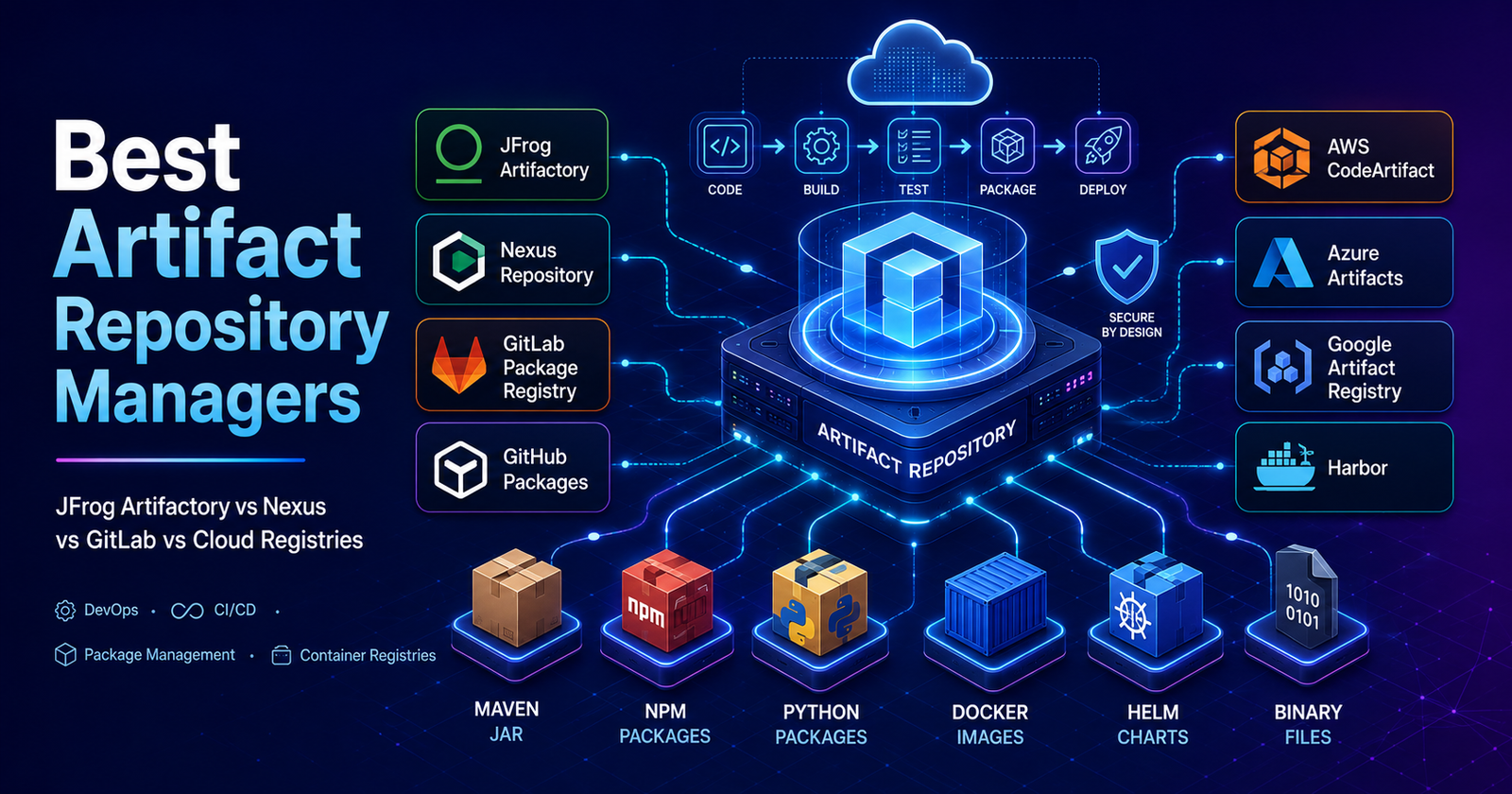
Artifact repositories store and distribute build outputs and dependencies such as Maven packages, npm modules, Python wheels, NuGet packages, container images, Helm charts, operating-system packages, and generic binaries. The right platform must fit package formats, security policy, delivery workflows, and operating capacity.

Platform overview

Platform typeStrongest fitMain consideration
ArtifactoryLarge multi-format enterprises and distribution workflowsLicensing, administration, and platform breadth
Nexus RepositoryMulti-format proxy and hosted repositoriesEdition features and operational design
GitLab Package RegistryTeams already standardizing on GitLabBest value when delivery lives in GitLab
Cloud-native registryWorkloads concentrated in one cloudPortability and cross-cloud access
HarborSelf-managed OCI container and Helm environmentsPrimarily container-focused operations

Essential capabilities

  • Hosted repositories for internal packages.
  • Proxy caching for approved upstream dependencies.
  • Virtual or group endpoints that simplify client configuration.
  • Fine-grained identity, permissions, tokens, and audit logs.
  • Retention, cleanup, immutability, and promotion controls.
  • Metadata, search, vulnerability integration, and provenance support.
  • Reliable backups, replication, monitoring, and disaster recovery.

Security and supply-chain controls

Centralize approved upstream sources, block anonymous publishing, use short-lived credentials where possible, scan components, preserve checksums, sign release artifacts, and separate development from production promotion. The repository should be a policy enforcement point, not only a file server.

Choose around existing workflows

A platform integrated with the existing source and CI/CD system reduces friction. A dedicated repository can provide broader format support and independence. A cloud-native service can reduce maintenance when most workloads already run in that cloud.

Evaluate with a representative pilot

  1. List every required package and container format.
  2. Test upstream proxy behavior and dependency caching.
  3. Verify identity, service accounts, permissions, and audit events.
  4. Run publish, promotion, rollback, and retention workflows.
  5. Measure client latency from build and deployment locations.
  6. Restore a backup and validate integrity.
  7. Estimate licensing, storage, egress, and staffing cost.

Avoid common design mistakes

Do not expose writable registries broadly, share administrator credentials, mix untrusted and release artifacts, retain everything forever, or depend on upstream public services during production deployment. Document ownership and recovery procedures before scaling adoption.

Artifactory and Nexus are strong multi-format repository platforms, GitLab works well for integrated delivery teams, cloud registries reduce infrastructure overhead in their ecosystems, and Harbor is compelling for self-managed OCI environments. Fit and governance matter more than feature count.

Did this help?

Yes No

Join the discussion

0 Comments

Ask questions, add context, or share what worked.

Sign in to join the discussion

No comments yet. Start the discussion.

More from Melochip Editorial

Related articles

Stay in the loop. Get new Melochip articles

Receive Melochip article updates when new articles are available. Explicit opt-in only.

No pre-checked boxes. Unsubscribe support is part of the subscriber foundation.