
Business Technology Business AnalyticsMarket IntelligenceResponsible AutomationWeb Data

Article & Tutorial

How Companies Use Web Data Collection to Monitor Market Trends

Learn how companies collect public web data for pricing, product, sentiment, availability, and competitive analysis while respecting legal, privacy, and operational boundaries.

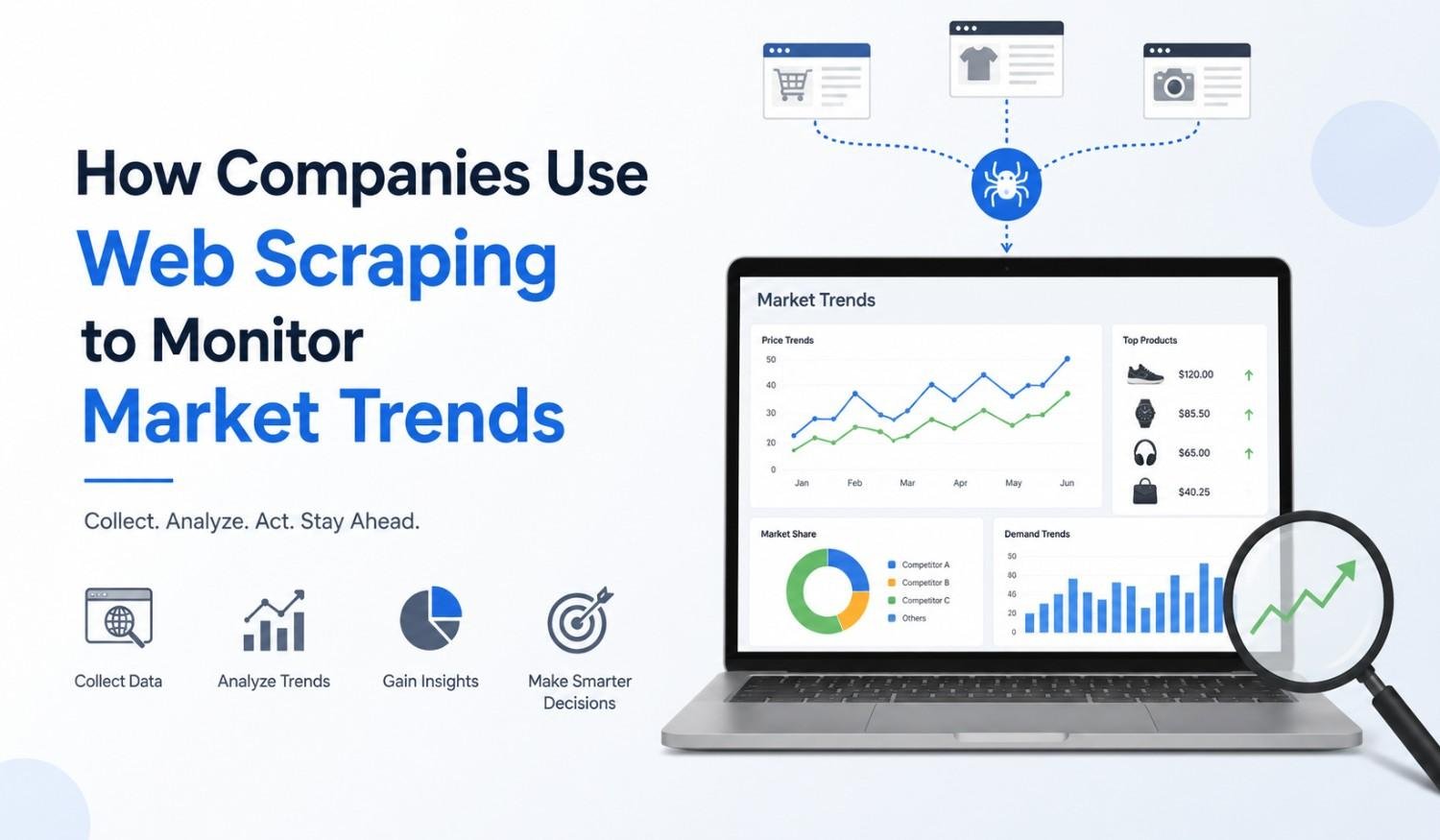
Business market trends dashboard built from responsible public web data collection
Contents

Companies use automated web data collection to track public signals such as prices, product availability, customer sentiment, hiring patterns, and competitor changes. The value comes from consistent, timely observations—not indiscriminate collection.

Common market-monitoring uses

Use caseExample signalBusiness action
Price intelligencePublished prices and promotionsReview positioning and margin
Product trackingNew listings and feature changesUpdate roadmap or assortment
AvailabilityStock and delivery estimatesAdjust supply and communications
Customer sentimentPublic reviews and discussion themesPrioritize service improvements
Industry monitoringAnnouncements and job postingsIdentify investment and demand patterns

Define the question before collecting data

Specify the decision, fields, sources, frequency, and acceptable delay. Collect only what supports the use case. A narrow, documented dataset is easier to validate, secure, and maintain than a broad archive created without purpose.

Legal and ethical boundaries

  • Prefer official APIs, feeds, exports, or licensed providers when available.
  • Review website terms, access restrictions, robots guidance, contracts, copyright, privacy, and applicable law.
  • Do not bypass authentication, technical controls, paywalls, or access limits.
  • Avoid collecting personal or sensitive information unless there is a clear lawful basis.
  • Identify the collector honestly where appropriate and provide a contact path.
  • Use conservative rates and stop when a site signals overload or denial.

A reliable data pipeline

  1. Schedule collection with per-source limits.
  2. Store raw observations with time and source metadata.
  3. Validate types, required fields, and plausible ranges.
  4. Detect layout changes and extraction failures.
  5. Normalize entities, currencies, units, and time zones.
  6. Load curated data into analytics storage.
  7. Monitor freshness, coverage, errors, and source health.

Quality challenges

Web pages change without notice, the same product may appear under different names, promotional prices can be conditional, and reviews may be duplicated or manipulated. Combine automated checks with human sampling and clearly communicate uncertainty.

Turn observations into decisions

Use dashboards and alerts to highlight meaningful change rather than every update. Compare trends over time, segment by market, and require corroborating evidence before major strategic action. Public web data is one input, not complete market truth.

Operate responsibly

Assign an owner for every source, retain only necessary data, protect collected datasets, document deletion rules, and review compliance as sources and business uses change. Responsible collection protects both the organization and the sites it observes.

Did this help?

Yes No

Join the discussion

0 Comments

Ask questions, add context, or share what worked.

Sign in to join the discussion

No comments yet. Start the discussion.

More from Melochip Editorial

Related articles

Stay in the loop. Get new Melochip articles

Receive Melochip article updates when new articles are available. Explicit opt-in only.

No pre-checked boxes. Unsubscribe support is part of the subscriber foundation.