
Rust Learning Path — Chapter 14. Traits describe shared behavior. They are central to reusable APIs, generic constraints, testing boundaries, and many of Rust's most expressive abstractions.
Define a trait
trait Summary { fn summarize(&self) -> String; }Implement a trait for a type
struct Article { title: String, author: String, } impl Summary for Article { fn summarize(&self) -> String { format!("{} by {}", self.title, self.author) } }Default implementations
trait Health { fn status(&self) -> &'static str { "healthy" } }A type can use the default or provide its own implementation.
Traits as function parameters
fn notify(item: &impl Summary) { println!("{}", item.summarize()); }The equivalent trait-bound form makes the generic parameter explicit:
fn notify<T: Summary>(item: &T) { println!("{}", item.summarize()); }Multiple trait bounds
use std::fmt::{Debug, Display}; fn print_value<T: Display + Debug>(value: &T) { println!("display={value}"); println!("debug={value:?}"); }where clauses
fn compare_and_print<T, U>(left: &T, right: &U) where T: std::fmt::Display + PartialOrd, U: std::fmt::Display, { println!("left={left}, right={right}"); }where clauses are especially useful when signatures would otherwise become difficult to read.
Returning impl Trait
fn create_summary() -> impl Summary { Article { title: String::from("Rust Traits"), author: String::from("Melochip"), } }Trait bounds unlock generic operations
fn largest<T: PartialOrd>(items: &[T]) -> &T { let mut largest = &items[0]; for item in &items[1..] { if item > largest { largest = item; } } largest }Mini lab: pluggable notifier
trait Notifier { fn send(&self, message: &str); } struct ConsoleNotifier; impl Notifier for ConsoleNotifier { fn send(&self, message: &str) { println!("NOTIFY: {message}"); } } fn alert(service: &str, notifier: &impl Notifier) { notifier.send(&format!("{service} is unavailable")); }Traits vs generics
Generics provide placeholders for types. Traits describe capabilities those types provide. In practice they are frequently used together: T: Trait.
Common mistakes
- Adding a bound that is stronger than the function actually needs.
- Trying to call methods on an unconstrained generic type.
- Assuming impl Trait can return unrelated concrete types from different branches.
- Using inheritance terminology where composition and trait behavior are more accurate.
Next: Chapter 15 — Lifetimes.
Join the discussion
0 CommentsAsk questions, add context, or share what worked.
More from Melochip Editorial

Learn what Playwright testing is, why modern QA teams use it, how testers can get started, and the major types...
7 min read · Sep 19, 2026

Learn how Kubernetes Deployments and ReplicaSets work with practical YAML, scaling, self-healing, rolling upda...
7 min read · Sep 17, 2026

Learn Kubernetes security best practices with RBAC, Secrets, ServiceAccounts, Pod securityContext, NetworkPoli...
6 min read · Sep 17, 2026Related articles
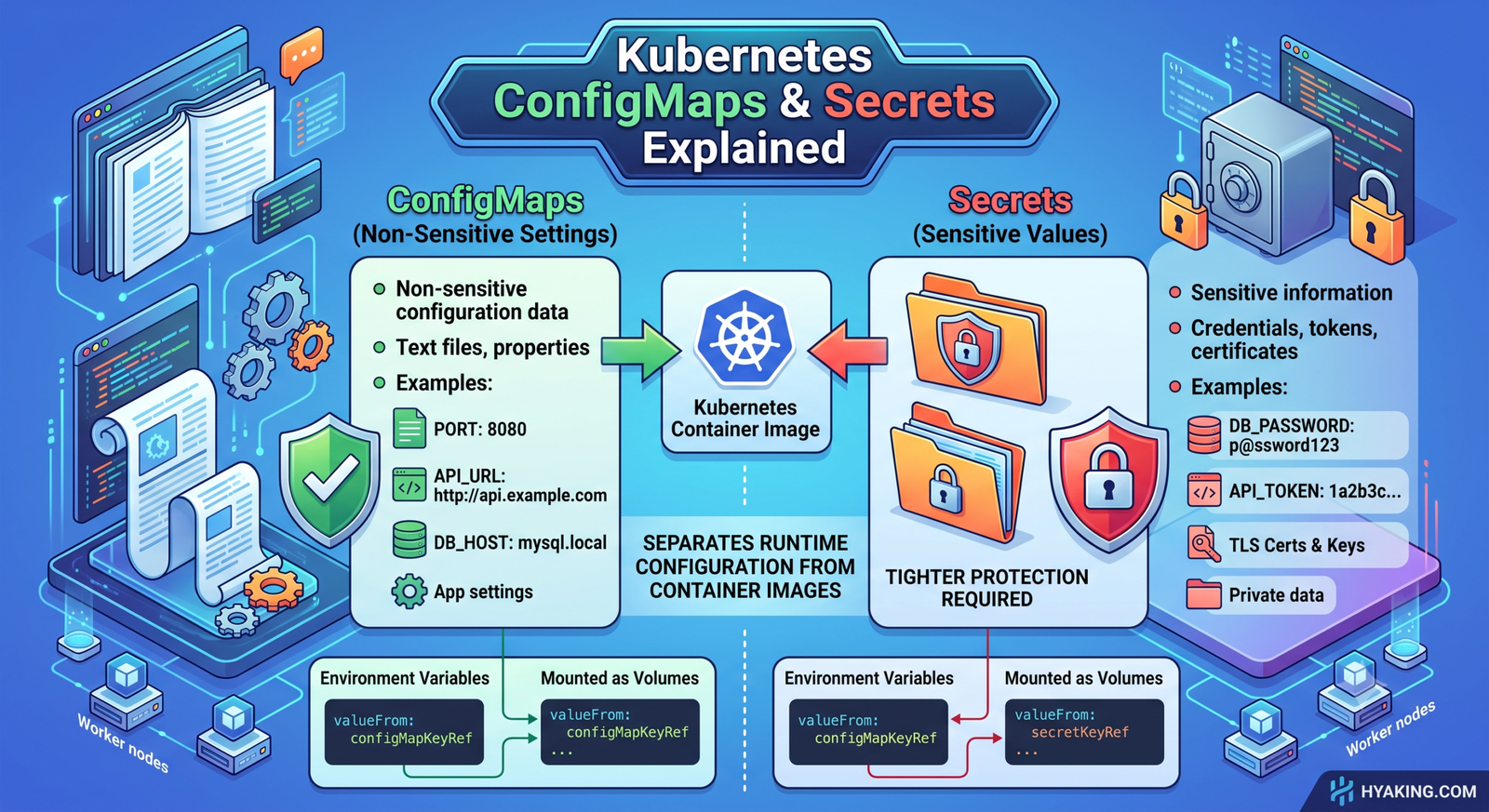
Learn Kubernetes ConfigMaps and Secrets with YAML, environment variables, file mounts, update behavior, immuta...
8 min read · Sep 17, 2026
Learn what Playwright testing is, why modern QA teams use it, how testers can get started, and the major types...
7 min read · Sep 19, 2026
Learn how Kubernetes Deployments and ReplicaSets work with practical YAML, scaling, self-healing, rolling upda...
7 min read · Sep 17, 2026
Learn Kubernetes security best practices with RBAC, Secrets, ServiceAccounts, Pod securityContext, NetworkPoli...
6 min read · Sep 17, 2026Stay in the loop. Get new Melochip articles
Receive Melochip article updates when new articles are available. Explicit opt-in only.
No comments yet. Start the discussion.