Search articles, utilities, learning content, community Q&A, members, tags, and topics.
Start with
Search areas
Choose an area such as Articles, Utilities, Community Q&A, Learning, Members, or Tags & topics.
RustMethodsownershipRustStructs
Article & Tutorial
Rust Structs and Methods: Fields, impl, Associated Functions and Ownership
Learn Rust structs and methods with named structs, tuple structs, unit structs, impl blocks, associated functions, ownership, borrowing and practical examples.
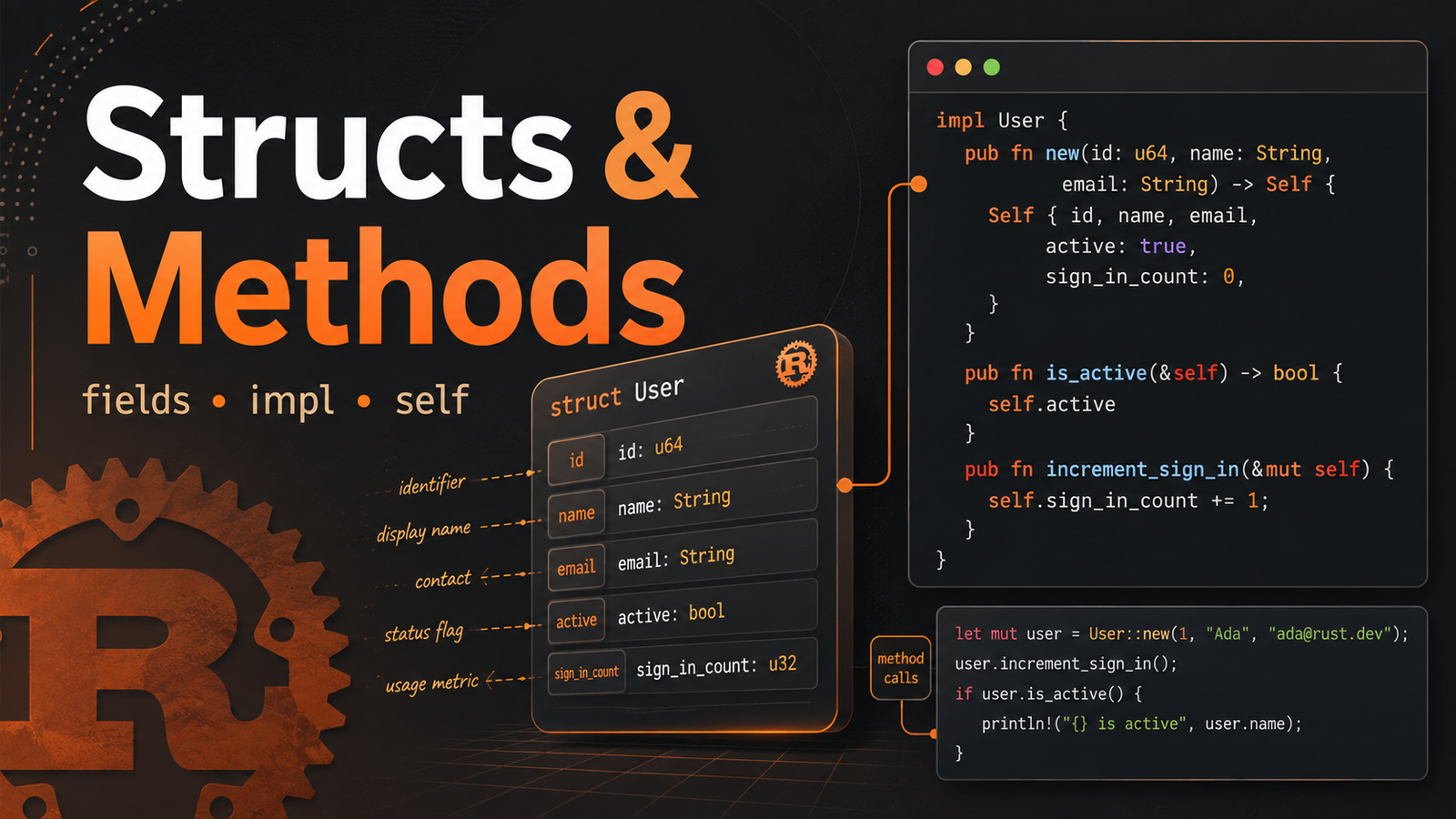
Rust Structs and Methods: Fields, impl, Associated Functions and Ownership article illustrationContents
Structs let you create meaningful custom data types by grouping related values together. Instead of passing separate variables such as a server name, port, TLS flag and retry count, you can represent the entire configuration as one type.
Define and instantiate a struct
bash
struct Server { name: String, port: u16, tls: bool, } fn main() { let server = Server { name: String::from("api-01"), port: 8080, tls: true, }; println!("{}:{}", server.name, server.port); }
Each field has a name and type. An instance must provide values for all required fields.
Mutable struct instances
bash
let mut server = Server { name: String::from("api-01"), port: 8080, tls: false, }; server.tls = true;
The complete instance is mutable; Rust does not let you mark only a single field as mut in the struct definition.
Field init shorthand
bash
fn build_server(name: String, port: u16) -> Server { Server { name, port, tls: true, } }
When parameter/variable names match field names, you can omit name: name.
Struct update syntax
bash
let primary = Server { name: String::from("primary"), port: 443, tls: true, }; let backup = Server { name: String::from("backup"), ..primary };
Be careful with ownership: fields that do not implement Copy can be moved from the source instance by update syntax. Here the explicitly replaced name changes how much of primary is moved, while copied scalar fields remain simple values.
Multiple impl blocks are valid and can help organize implementations.
Owned vs borrowed fields
bash
struct User { username: String, }
An owned String means the struct owns the username and can live independently of the text used to construct it. Storing references inside structs is possible, but usually requires lifetime relationships. We cover lifetimes later in the learning path.
derive can ask the compiler to generate implementations of supported traits such as Debug, Clone, PartialEq and others when their requirements are met.
Prefer a struct when field names improve meaning. Compare:
bash
let server = ("api", 443, true); // What does server.2 mean? struct Server { name: String, port: u16, tls: bool, } // server.tls is self-explanatory
Common errors
Trying to modify a field when the struct variable is not mutable.
Moving a String field out and then trying to use the original instance as though it were complete.
Taking self in a method when &self would be sufficient.
Cloning fields unnecessarily instead of borrowing them.
Using references as struct fields without understanding the lifetime relationship.
Hands-on mini lab: service configuration
bash
cargo new structs_lab cd structs_lab
Create a Service struct with name , port , enabled and retries .
Add a new associated function.
Add an endpoint(&self) method.
Add enable(&mut self) .
Derive Debug and print the complete value.
Create a second instance using struct update syntax and observe which fields move or copy.
bash
cargo fmt cargo clippy cargo test cargo run
Key points
Structs group related values into a custom type.
impl blocks attach behavior to a type.
&self reads, &mut self modifies, and self consumes.
Associated functions are called with Type::function() .
Ownership rules still apply to fields and struct update syntax.
Use named fields when they make code easier to understand.
Next chapter
Structs model data with one fixed shape. Rust enums let one type represent multiple valid states. Continue with Chapter 10: Enums, Option and Pattern Matching.







No comments yet. Start the discussion.