
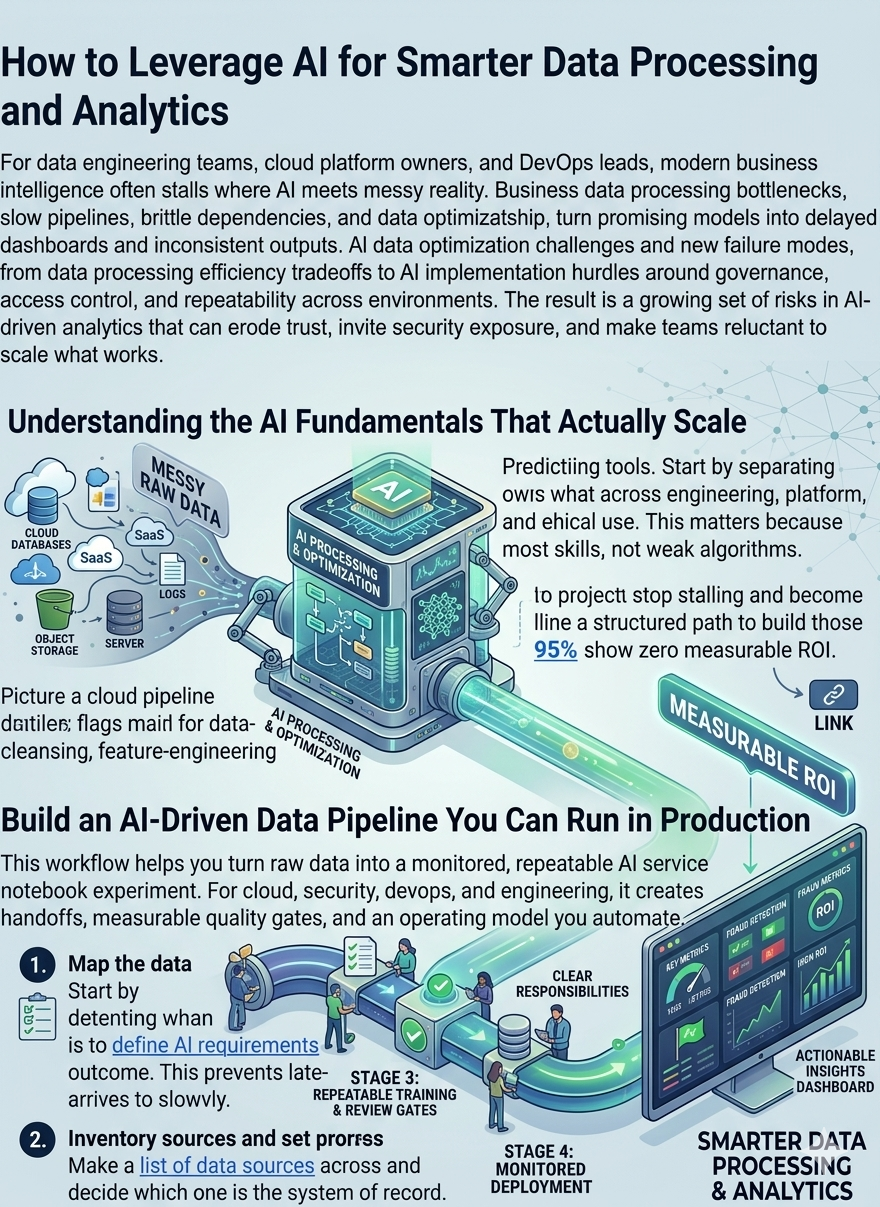
AI can accelerate data classification, anomaly detection, forecasting, enrichment, and natural-language analysis, but it cannot compensate for unclear ownership or unreliable source data. Successful systems combine dependable data engineering with measurable models and human accountability.
Start with a business decision
Define the decision or workflow that should improve, the users who act on the result, the acceptable error rate, and the cost of false positives and false negatives. A model metric is useful only when it connects to a business or operational outcome.
High-value use cases
| Use case | AI contribution | Required safeguard |
|---|---|---|
| Data quality | Detect unusual values and schema drift | Rules, lineage, and human triage |
| Document processing | Extract and classify fields | Confidence thresholds and sampling |
| Forecasting | Estimate demand or capacity | Backtesting and scenario review |
| Fraud or risk signals | Prioritize suspicious events | Fairness checks and appeal paths |
| Analytics assistant | Translate questions into analysis | Access control and result verification |
Build on a dependable data foundation
- Define data owners and quality expectations.
- Track lineage from source to dashboard or model.
- Version transformations, features, prompts, and model configurations.
- Separate training, evaluation, and production datasets.
- Protect sensitive fields with least privilege and retention rules.
- Monitor freshness, completeness, distribution drift, and failed jobs.
Use automation where confidence is appropriate
Low-risk, reversible work can be automated at lower confidence thresholds. High-impact actions should require stricter evidence or human approval. Design fallback behavior for unavailable models, malformed outputs, slow responses, and cost spikes.
Evaluate more than accuracy
Measure latency, cost, reliability, calibration, subgroup behavior, data freshness, operator workload, and downstream impact. Compare the AI-assisted process with a clear baseline so improvements are real rather than anecdotal.
Operate AI like a production system
- Log inputs and outputs with privacy controls.
- Monitor model, data, and pipeline drift.
- Review access permissions and third-party data handling.
- Test rollback and graceful degradation.
- Collect user feedback and investigate recurring overrides.
- Revalidate after model, prompt, schema, or policy changes.
A safe adoption path
Begin with one bounded workflow, run in shadow mode, compare results with existing decisions, document failure modes, and expand only when evidence supports it. Clear ownership and observability usually create more value than adding additional models.
Join the discussion
0 CommentsAsk questions, add context, or share what worked.
More from Melochip Editorial
Learn what Playwright testing is, why modern QA teams use it, how testers can get started, and the major types...
7 min read · Sep 19, 2026

Learn how Kubernetes Deployments and ReplicaSets work with practical YAML, scaling, self-healing, rolling upda...
7 min read · Sep 17, 2026

Learn Kubernetes security best practices with RBAC, Secrets, ServiceAccounts, Pod securityContext, NetworkPoli...
6 min read · Sep 17, 2026Related articles

Learn what Playwright testing is, why modern QA teams use it, how testers can get started, and the major types...
7 min read · Sep 19, 2026
Learn how Kubernetes Deployments and ReplicaSets work with practical YAML, scaling, self-healing, rolling upda...
7 min read · Sep 17, 2026
Learn Kubernetes security best practices with RBAC, Secrets, ServiceAccounts, Pod securityContext, NetworkPoli...
6 min read · Sep 17, 2026
Learn Kubernetes monitoring and logs with kubectl logs, events, metrics-server, top commands, Prometheus, Graf...
5 min read · Sep 17, 2026Stay in the loop. Get new Melochip articles
Receive Melochip article updates when new articles are available. Explicit opt-in only.
No comments yet. Start the discussion.